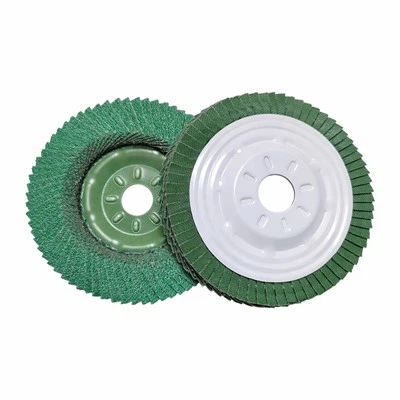
Hey there! I’m a supplier of Abrasive Polishing Wheels, and I’ve been in this business for quite a while. One question that often comes up from my customers is, "What’s the relationship between the abrasive’s hardness and the material being polished?" It’s a super important topic, and I’m gonna break it down for you. Abrasive Polishing Wheel

Let’s start by understanding what hardness means in the context of abrasives. Hardness, in simple terms, is how resistant an abrasive is to scratching or deformation. We usually measure it on the Mohs scale, which goes from 1 (softest) to 10 (hardest). For example, talc is a 1 on the Mohs scale, while diamond, the hardest natural material, is a 10.
Now, when we talk about the material being polished, different materials have different levels of hardness too. Metals, plastics, ceramics – they all vary. And the key is to match the right abrasive hardness to the material you’re working on.
If you’re polishing a soft material like aluminum, using an extremely hard abrasive can be a big mistake. A super – hard abrasive, say a diamond – based one, is way too aggressive for aluminum. It’ll scratch the surface like crazy and might even remove more material than you intended. In this case, a softer abrasive like silicon carbide is a much better choice. Silicon carbide has a hardness that’s just right to gently remove any imperfections on the aluminum surface without causing excessive damage.
On the other hand, when you’re dealing with a really hard material like stainless steel or hardened steel, you need a tough abrasive. Aluminum oxide is a popular option here. It’s hard enough to cut through the tough surface of the steel and remove any rust, scale, or rough edges. If you were to use a soft abrasive on stainless steel, it would take forever to get any results. The abrasive would wear out quickly, and you’d be left with an uneven and unpolished surface.
Ceramics are another interesting case. They’re pretty hard, but they’re also brittle. So, you need to be a bit careful. A zirconia – alumina abrasive is a good pick for ceramics. It has the right balance of hardness and toughness. It can grind away at the ceramic surface without cracking or chipping the material.
Now, let’s talk about how the hardness of the abrasive affects the polishing process. When you’re using a hard – enough abrasive for the material, it cuts through the surface more effectively. This means you can achieve a smoother finish in less time. For example, if you’re using a grinding wheel with the correct abrasive hardness on a piece of chrome – plated metal, you’ll be able to remove any scratches and blemishes quickly. The hard abrasive particles will break down the surface irregularities, and with a bit of pressure and the right speed, you’ll get a nice, shiny finish.
But if the abrasive is too soft for the material, it won’t cut through. You’ll end up spending a ton of time trying to polish, and you might not even get the results you want. The abrasive will just roll over the surface without really doing any significant work. It’s like trying to cut through a log with a butter knife.
Another thing to consider is the wear rate of the abrasive. Harder abrasives tend to wear out more slowly when they’re used on an appropriately hard material. This is great for cost – effectiveness. If you’re running a large – scale polishing operation, using the right – hardness abrasive means you’ll have to replace the polishing wheels less frequently.
For instance, if you’re in the automotive industry, polishing engine parts made of high – strength steel, using a hard and durable abrasive like cubic boron nitride (CBN) is a smart choice. CBN is almost as hard as diamond, and it can handle the high – pressure and high – speed conditions of industrial polishing. It’ll last a long time, and you’ll keep your production costs down.
I’ve seen many situations where people选错了 abrasive hardness. I remember one customer who was trying to polish a set of brass fittings with a very hard diamond – coated wheel. They thought that since diamond was the hardest, it would give them the best results. But in reality, they ended up with scratched and dull – looking fittings. When they switched to a softer, more appropriate abrasive, they got the beautiful, shiny finish they were after.
So, how do you choose the right abrasive hardness for your project? Well, it’s not always easy, but there are a few guidelines. First, you need to know the hardness of the material you’re polishing. You can usually find this information in material specifications or by doing some simple tests. Second, think about the finish you want to achieve. If you’re going for a high – gloss finish, you might need to use a series of abrasives, starting with a coarser one to remove the major imperfections and then finishing with a finer one for that smooth shine.
As an Abrasive Polishing Wheel supplier, I’ve got a wide range of products to meet different needs. Whether you’re working on a small DIY project at home or running a large – scale industrial operation, I can help you find the perfect abrasive with the right hardness.
If you’re still not sure which abrasive is best for your job, don’t hesitate to reach out. I’m here to offer advice and support. You can come to me and share the details of your project, like what material you’re polishing, what kind of finish you’re aiming for, and the scale of your operation. Together, we can figure out the ideal abrasive hardness and the right polishing wheel for you.
In conclusion, the relationship between the abrasive’s hardness and the material being polished is crucial. Getting it right can save you time, money, and a lot of frustration. So, take the time to understand your materials and choose the appropriate abrasives. And if you need any help, just give me a shout. I’m always happy to help you make your polishing projects a success.
Flap Disc References:
- "Handbook of Abrasive Technology" by John C. Williams
- "Abrasive Machining Processes" by Peter K. Wright and W. Brian Rowe
Henan Yandisc Hardware Tools Co., Ltd.
As one of the most professional abrasive polishing wheel manufacturers and suppliers in China, our products have good reputation in the market. Please feel free to wholesale high quality abrasive polishing wheel made in China here from our factory. Customized orders are welcome.
Address: Zinan Road, High-tech Industrial Development Zone, Zhengzhou, Henan, China
E-mail: info@yandisc.com
WebSite: https://www.yandisc.com/
