Hey guys, if you’re reading this, you’re probably on the hunt for a new toilet (or just sprucing up your bathroom) and landed on two-piece toilets—smart choice, by the way. As someone who’s been in the two-piece toilet supply game for almost a decade, I’ve seen so many folks nail their bathroom renos… and a lot of them mess up the matching part. It’s not just about picking a toilet that looks “okay” next to your vanity or sink—there’s actual logic here, not just guessing. Let’s break this down like we’re chatting over coffee, no stuffy industry jargon, promise. Two Piece Toilet

First, let’s get one thing straight: two-piece toilets are still the workhorses of bathrooms, right? They’re way easier to ship, cheaper to repair if something breaks, and way more flexible in terms of sizing than one-piece models. But the big question everyone asks me is: how do I pair mine with other fixtures so it doesn’t look like a random collection from three different stores?
Let’s start with the most important matching factor: scale. That’s the biggest mistake people make. You know that feeling when you walk into a bathroom where the toilet’s tiny (like, compact for a half-bath) but the vanity is double-sink and huge? Or vice versa—your toilet is a big, bulky, commercial-grade one for a master bath, but your sink is a tiny pedestal that looks like it belongs in a kid’s bathroom. That’s a scale mismatch, and it’s way more noticeable than color. Let me tell you how to fix that.
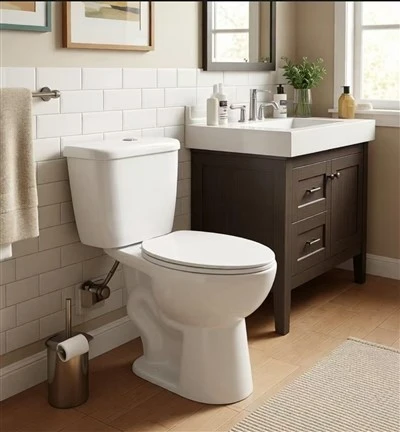
If your bathroom’s on the smaller side—say, a powder room (half-bath) that’s 5×8 feet or less—go for a compact two-piece toilet. These are usually 27 to 28 inches from the tank to the bowl, so they don’t eat up floor space. For the other fixtures here: stick to a small pedestal sink (20-24 inches wide max) or a narrow floating vanity. I always tell folks, if your toilet fits a small footprint, don’t pair it with a 30-inch wide vanity—it’ll crowd the whole room. For a medium bathroom (6×10 feet, standard master half-bath or full bath), go for a standard two-piece toilet: 28 to 30 inches long, 15-inch rough-in (that’s the distance from the wall to the center of the drain pipe—super important, don’t skip measuring that!). Pair that with a 30 to 36 inch vanity, a standard under-mount sink, and a mirror that’s not bigger than the vanity. For a large master bath (8×12 feet or more), you can go for a comfort-height two-piece toilet (17-19 inches from the floor to the seat, way comfier for adults) paired with a 48 to 60 inch double vanity, a vessel sink if you’re feeling fancy, and a large framed mirror. Scale isn’t just about size, either—proportion. If your toilet has a tank that’s tall and narrow, don’t pair it with a short, wide vanity. It’ll feel unbalanced.
Next up, color matching (or lack thereof—let’s be real, not everyone wants all white). This is where I see the most chaos, because people either go full “matchy-matchy” to the point of being boring, or they pick random colors that clash. Let’s keep it simple, no rules that feel restrictive. First, neutral colors: white, off-white, biscuit, bone, gray. These are the most popular for a reason—they work with almost everything. If you have a white two-piece toilet, you can pair it with a white vanity, a gray quartz countertop, a chrome faucet, or a matte black mirror. It’s versatile. But if you want to mix it up, don’t try to match exact shades. For example, if your toilet is “off-white” (sometimes called bone or cream), don’t get a pure white vanity. That’ll look like two different colors next to each other. Instead, go for the same warm undertone—if your toilet is warm off-white, pick a vanity with warm wood tones or a cream finish, not cool white. If your toilet is gray, don’t pair it with a beige sink or a white vanity that’s too stark. Gray has cool undertones, so stick to cool neutrals for the rest of the fixtures.
Now, what about bold colors? I’ve sold a lot of blue two-piece toilets, even black ones, for people who don’t want boring. The key here is to use the toilet as a statement piece, not the only one. If your toilet is matte black, don’t get a white vanity and a chrome faucet—too much contrast is jarring. Instead, pair it with a matte black faucet, a black mirror frame, and a white vanity with a black countertop. That way, the black toilet ties in with the other black fixtures, and the white vanity balances it out. If your toilet is navy blue, go for a light wood vanity, a brushed gold faucet, and a subway tile backsplash. The blue is the pop, and the other fixtures are warm enough to not compete. One thing I always warn against: don’t mix too many bold colors in a small bathroom. If you have a blue toilet, a green shower curtain, and a red towel rack, that’s a headache for the eyes. Pick one statement color, keep the rest neutral or in complementary tones.
Then there’s finish matching—wait, this is different from color, right? Yeah, finish is the texture of the fixture parts. Faucets, towel bars, mirror frames, light switch plates—these finishes need to match, not just the toilet. Let’s say your two-piece toilet has a chrome flush lever (super common) and a white bowl. Don’t get a matte black faucet and a brushed gold towel bar. Those finishes are totally different tones and textures, and it’ll look like you raided three different home stores. The rule here: pick one metal finish (chrome, brushed nickel, matte black, gold, bronze) and stick with it for all your metal fixtures. If you have a chrome toilet lever, go for chrome faucet, chrome towel bars, chrome light fixtures. If you have a matte black toilet, go for matte black everything else. Wait, but what if you want to mix? A lot of people do mixed metals now, and it looks great—if you do it right. Stick to two finishes max, and they should be in the same temperature. For example, chrome (cool) and brushed nickel (warm) don’t mix well, but matte black (cool) and brushed gold (warm) work together. Just don’t throw three in there. I’ve seen people come to me with a toilet that has a brushed gold lever and then a kitchen-style chrome faucet, and it’s a total eyesore—easily avoidable.
Wait, let’s talk about a specific scenario that trips people up: matching a two-piece toilet with a shower or tub. A lot of folks focus on the vanity and sink, but the shower/tub fixtures matter too. If your bathroom has a shower, and your two-piece toilet is white, the shower tile can be white or a soft color, but the showerhead and faucet should match the other metal finishes, obviously. If your toilet is beige, and your tile is gray, that’s okay—just make sure the grout is a neutral that doesn’t clash. A common mistake: if you have a pedestal sink with a chrome faucet, and your tub faucet is matte black, it sticks out. Fix that by either swapping the sink faucet or the tub faucet to match, or add a little metal tray on the vanity that has both finishes? No, wait, that’s overcomplicating. Just pick one metal and stick. Also, if you have a two-piece toilet with a skirted bowl (that hides the trapway, looks sleeker), that pairs well with a modern floating vanity or a sleek shower glass enclosure. If your toilet is a more traditional model with a exposed trapway, it goes better with a classic vanity or a tile shower with a traditional subway pattern.
Oh, and don’t forget functionality! I know we’re talking about matching, but if you pick a toilet that’s too small for your needs, even if it matches perfectly, it’ll drive you crazy. If you have a family of four, go for a comfort-height two-piece toilet with a 1.28 GPF (gallons per flush) rating—water-efficient, works great for multiple people. Pair that with a vanity that has enough storage, and a sink that’s deep enough for kids to wash their hands without spilling. It’s no good if everything matches size-wise, but the toilet is too small for your family. That’s why I always tell folks to measure their bathroom first, figure out their needs, then pick the toilet, then match the rest. Don’t pick the vanity first and force a toilet to fit it—you’ll end up with something that looks weird.
Wait, let’s share a quick example to make this real. Last month, a customer came to me looking for a two-piece toilet for her 6×11 foot master bathroom. She had a medium oak vanity with a white quartz countertop and a brushed gold faucet. She wanted something that didn’t clash with the vanity. We went with a classic white two-piece comfort-height toilet—same white as the quartz, so it blends perfectly, and the tank is a standard size, so it doesn’t overwhelm the oak vanity. She added a brushed gold mirror frame and gold towel bars, so all the metal finishes matched. It looked so good when she installed it—she told me her friends thought she hired a high-end designer, but it was just picking scale, color, and finish.
Another example: a guy who was renovating a small powder room, 5×7 feet. He wanted a bold look, so he picked a matte black compact two-piece toilet. I told him, don’t pair that with a white pedestal sink and chrome faucet. Instead, he went with a small black pedestal sink (that matches the toilet) and a brushed gold faucet. The black and gold looked sleek, didn’t make the small room feel cramped, and was way more unique than a plain white powder room. He texted me a photo later, and it looked awesome—no clashing, just intentional matching.
Now, what are the mistakes to avoid at all costs? Let’s list them out, because I’ve seen these way too many times:
-
Mismatched rough-in size: If your drain pipe is 12 inches from the wall, don’t buy a toilet with a 10-inch rough-in. It won’t fit, no matter how good it matches. I always tell customers to measure that before they even look at toilets. It’s $10 at a hardware store for a measuring tape, don’t skip it.
-
Too many bold colors in a small space: We talked about this, but it bears repeating. A 5×7 powder room can’t handle a navy toilet, red sink, and green shower curtain. Pick one pop color, keep the rest neutral.
-
Random metal finishes: If you have a toilet with a chrome lever, don’t go buy a matte black towel bar at the last minute. It’ll look like an afterthought. Plan your finishes together—pick all metal fixtures at the same time as your toilet.
-
Ignoring the overall style: If your bathroom is modern with clean lines (no ornate molding), don’t pair a traditional two-piece toilet with a curved tank. It’ll clash. If it’s a vintage bathroom with clawfoot tub and tile, go for a two-piece toilet with a classic rounded bowl and a pedestal tank—fits the style perfectly.
Wait, one last tip: test before you commit. A lot of people buy online, which is fine, but if you can, see the toilet in person before you buy. Hold the flush lever, look at the color next to sample swatches of your vanity and sink. A lot of times, white looks different in store vs online—some have a blue undertone, some yellow, and if your vanity is warm yellow, a white toilet with a blue undertone will look off. If you’re buying online, order a free color swatch from your toilet brand, and match it to your vanity’s swatch. That’s a hack I give all my customers.
At the end of the day, matching a two-piece toilet with other fixtures isn’t about following strict rules—it’s about being intentional. It’s about picking a toilet that fits your space, your needs, and then tying in the other fixtures with scale, color, and finish so everything feels cohesive, not random. Two-piece toilets are such a practical, affordable choice, so you don’t have to sacrifice style for function.
If you’re in the middle of a bathroom reno and need help picking the right two-piece toilet, or want to talk about how to match it with your existing fixtures, feel free to reach out to our team to chat through your options. We’ve got tons of styles, sizes, and colors, and we’re here to make sure your bathroom turns out exactly how you want it.
Cabinet Basin References
- National Association of Home Builders (NAHB) Bathroom Design Guidelines, 2022
- EPA WaterSense Toilet Specifications and Compatibility Tips, 2023
- Kitchen & Bath Industry Show (KBIS) 2024 Fixture Matching Trends Report
- Residential Plumbing Industry Association (RPIA) Two-Piece Toilet Installation Best Practices, 2021
Tangshan Houfengyuan Import and Export Co., Ltd.
As one of the most professional two piece toilet manufacturers and suppliers in China, our products have good reputation in the market. We warmly welcome you to wholesale customized two piece toilet from our factory. Good service and quality products are available.
Address: COMPREHENSIVE SERVICE PARK BUILDING,No.3 ROOM 216 MEIYI ROAD No.14 LUBEI,TANGSHAN CITY, HEBEI PROVINCE,CHINA
E-mail: hfy01@hfybath.com
WebSite: https://www.hfy-bath.com/
