In the ever-evolving landscape of industrial machinery, the pole-changing two-speed three-phase motor stands out as a remarkable piece of engineering. As a proud supplier of these versatile motors, I’ve witnessed firsthand their impact on various industries. In this blog, I’ll delve into the electromagnetic characteristics of pole-changing two-speed three-phase motors, exploring their working principles, benefits, and applications. Pole-Changing Two-Speed Three-Phase Motor
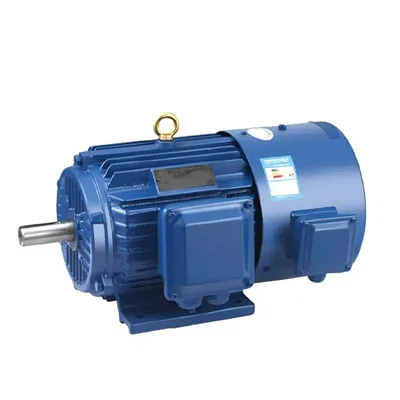
Fundamentals of Electromagnetic Fields in Three-Phase Motors
To understand the electromagnetic characteristics of pole-changing two-speed three-phase motors, we first need to grasp the basic concepts of three-phase motors. A three-phase motor operates on the principle of a rotating magnetic field. When three-phase alternating current (AC) is supplied to the stator windings of the motor, it creates a magnetic field that rotates at a synchronous speed.
The synchronous speed ($n_s$) of a three-phase motor is given by the formula:
[n_s=\frac{120f}{p}]
where $f$ is the frequency of the AC supply and $p$ is the number of poles. This formula shows that the synchronous speed is inversely proportional to the number of poles. For example, at a standard frequency of 50 Hz, a two-pole motor will have a synchronous speed of 3000 revolutions per minute (RPM), while a four-pole motor will have a synchronous speed of 1500 RPM.
Pole-Changing Principle
The key feature of a pole-changing two-speed three-phase motor is its ability to change the number of poles in the stator windings. By altering the connection of the stator coils, the motor can operate at two different speeds. There are two main methods for pole-changing: the consequent-pole method and the change-over winding method.
Consequent-Pole Method
In the consequent-pole method, the stator windings are arranged in such a way that by reversing the current direction in some of the coils, the number of poles can be changed. For example, a motor can be designed to operate as a four-pole motor in one connection and an eight-pole motor in another connection. This method is relatively simple and cost-effective, but it has some limitations in terms of the ratio of the two speeds.
Change-Over Winding Method
The change-over winding method involves using two separate sets of stator windings with different numbers of poles. By switching between the two sets of windings, the motor can achieve a wider range of speed ratios. This method is more complex and expensive than the consequent-pole method, but it offers greater flexibility in terms of speed selection.
Electromagnetic Characteristics of Pole-Changing Two-Speed Three-Phase Motors
Torque-Speed Characteristics
The torque-speed characteristics of a pole-changing two-speed three-phase motor vary depending on the number of poles. At low speeds (with more poles), the motor typically has a higher starting torque and a lower maximum speed. This makes it suitable for applications where high starting torque is required, such as in conveyor belts and crushers. At high speeds (with fewer poles), the motor has a lower starting torque but a higher maximum speed, which is ideal for applications such as fans and pumps.
Efficiency
The efficiency of a pole-changing two-speed three-phase motor is an important consideration. Generally, the motor operates most efficiently at or near its rated speed. When the motor is operating at a speed different from its rated speed, the efficiency may decrease due to increased losses in the stator and rotor windings. However, modern pole-changing motors are designed to maintain relatively high efficiency over a wide range of speeds.
Power Factor
The power factor of a three-phase motor is a measure of how effectively it converts electrical power into mechanical power. Pole-changing two-speed three-phase motors typically have a good power factor, especially at their rated speeds. However, like efficiency, the power factor may decrease when the motor is operating at speeds far from its rated speed.
Applications of Pole-Changing Two-Speed Three-Phase Motors
The unique electromagnetic characteristics of pole-changing two-speed three-phase motors make them suitable for a wide range of applications. Some of the common applications include:
Industrial Fans
In industrial ventilation systems, fans often need to operate at different speeds depending on the ventilation requirements. Pole-changing two-speed motors allow fans to adjust their speed easily, providing efficient and flexible ventilation.
Pumps
Pumps used in water supply, drainage, and irrigation systems also benefit from the variable speed capabilities of pole-changing motors. By adjusting the speed of the pump, it is possible to control the flow rate and pressure of the fluid, saving energy and reducing wear and tear on the pump.
Conveyor Belts
Conveyor belts in manufacturing and logistics industries require different speeds for different operations. Pole-changing two-speed motors enable conveyor belts to change their speed smoothly, improving productivity and efficiency.
Advantages of Choosing Our Pole-Changing Two-Speed Three-Phase Motors
As a supplier of pole-changing two-speed three-phase motors, we take pride in offering high-quality products with several advantages:
Customization
We understand that different applications have different requirements. That’s why we offer customized solutions to meet the specific needs of our customers. Whether you need a motor with a specific speed ratio, torque requirement, or voltage rating, we can design and manufacture a motor that fits your application perfectly.
Reliability
Our motors are built to last. We use high-quality materials and advanced manufacturing processes to ensure the reliability and durability of our products. Rigorous testing is carried out on each motor before it leaves our factory to guarantee its performance and quality.
Technical Support
We provide comprehensive technical support to our customers. Our team of experienced engineers is available to answer your questions, provide installation and maintenance guidance, and offer solutions to any problems you may encounter.
Conclusion

In conclusion, the electromagnetic characteristics of pole-changing two-speed three-phase motors make them a versatile and efficient choice for a wide range of industrial applications. Their ability to change speed easily, combined with their good torque-speed characteristics, efficiency, and power factor, make them an ideal solution for many industries.
YE3 Three-Phase Motor If you’re in the market for a reliable and high-performance pole-changing two-speed three-phase motor, we invite you to contact us for a detailed discussion about your requirements. Our team is ready to assist you in finding the perfect motor for your application.
References
- Fitzgerald, A. E., Kingsley, C., Jr., & Umans, S. D. (2003). Electric Machinery (6th ed.). McGraw-Hill.
- Chapman, S. J. (2012). Electric Machinery Fundamentals (5th ed.). McGraw-Hill.
- Kraus, J. D., & Carver, K. R. (1973). Electromagnetics (2nd ed.). McGraw-Hill.
Taizhou Goodpump Trading Co., Ltd.
We’re well-known as one of the most professional pole-changing two-speed three-phase motor enterprises in China, featured by quality products and good service. Please rest assured to buy discount pole-changing two-speed three-phase motor in stock here from our factory. For quotation, contact us now.
Address: No. 38, District 6, Zhengye Village, Lunan Street, Luqiao District, Taizhou City, Zhejiang Province, China
E-mail: 19548175755@163.com
WebSite: https://www.goodpump-cn.com/
